
Water Line Replacement
At Wylie Pipe Pros, we provide water line replacement services for homes and businesses throughout Wylie. If an aging or damaged line is causing leaks, low water pressure, discoloration, or repeated repairs, we can assess the system and replace the failing section with a dependable new water line.
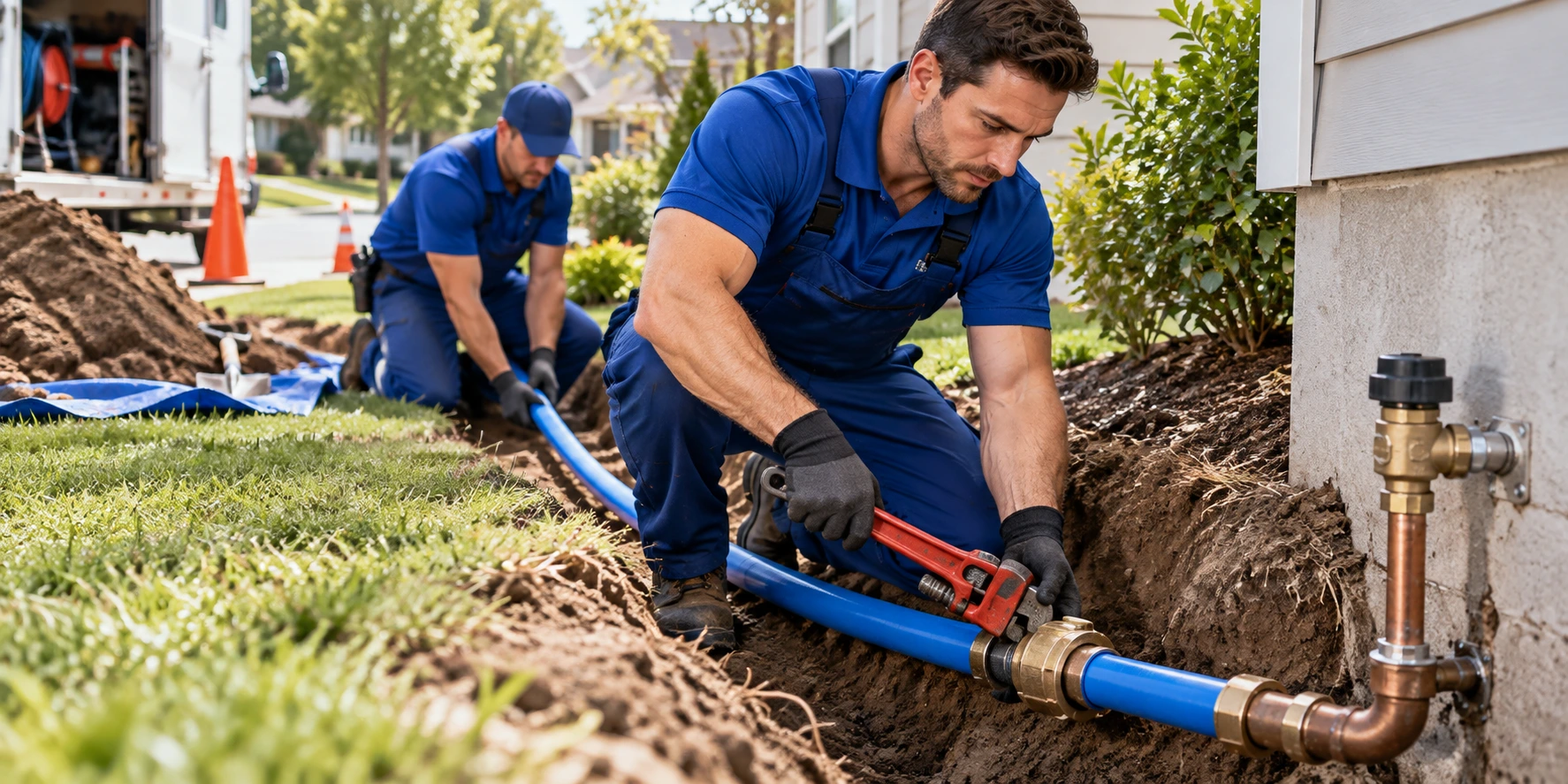
Water line replacement in Wylie for meter-to-house lines
When a service pipe between the meter and the slab starts to leak or starve the house of pressure, we take on water line replacement in Wylie for homeowners in houses, townhomes, and condos, and we run the same work in Lavon, Nevada, Josephine, and Caddo Mills. Wylie Pipe Pros follows that buried run, checks house pressure, and decides whether a short repair will hold or the line has to come out. The drains and the hot water heater still matter, because they are the equipment those lines feed.
A visit can also include pipe repair inside the walls, leak detection when the wet spot is not obvious, and emergency plumbing after a burst. Drain cleaning, fixture installation, and garbage disposal repair still show up on the same visit when those fixtures starve for water. In 75098 the 1990s and 2000s streets around Woodbridge still carry a lot of copper and PVC.
The older cottages near Olde City Park often keep galvanized on the street side of the house. We test pressure and isolation before we open a trench, and we leave the lawn and the meter box as tidy as the work allows. The shop answers 24/7, so a wet stripe in the yard does not have to wait for weekday hours. Once those first readings are on paper, the rest of the visit follows a clear order.
Other Services
Contact Us Today!
(945) 325-5651
Open 24 Hours
Reliable plumbing solutions for homes and businesses throughout Wylie, TX.
Professional repairs and installations completed with care, attention, and lasting results.
Need urgent plumbing help? Call Wylie Pipe Pros for fast assistance with leaks, burst pipes, backups, and other plumbing emergencies.call now
What we test on a water line first
On a Wylie lot the order of the readings matters, because the wrong hole in the yard does not answer the question. We start at the street, then the house, then the pipe in between, and only then do we talk about trench length. Same-day diagnosis is the set of those gauge readings on the first visit. Each step rules something out before a shovel hits Houston Black clay.
Street pressure at the meter setter
The meter setter is the yoke that holds the meter in the box, and a gauge there shows what the main is actually delivering. If that number is already weak, the yard pipe is not the whole story and we do not replace a healthy lateral for a utility problem. A strong street reading tells us the city side can feed the house. That is why the box comes before any hose bib on the slab.
House-side pressure at a hose bib
Static pressure, the reading with no fixture open, gets taken at a hose bib on the house side next. We compare that number with the meter-side gauge. If street pressure looks normal and the bib is down about 10 psi with everything off, the restriction or the leak sits in the buried pipe, not in a faucet cartridge. That drop is the threshold that sends us looking along the meter-to-house path.
Isolation and a hold on the yard pipe
With the house valve closed, the meter should sit still if the lateral is tight. A meter that still creeps, or a gauge that will not hold, means water is leaving the pipe in the soil. That hold test is what separates a slab leak inside the footprint from a yard leak on the customer side of the meter. It also tells us whether a coupling at the setter could be the only failure.
Material, cover, and the replacement path
Once the numbers say the lateral is the job, we look at what is in the ground and how deep it sits. Copper, galvanized, PVC, and PEX fail in different ways in this clay, and a driveway or a sidewalk changes how we open the run. Tracer wire on newer PEX helps us stay on the pipe. The path we mark is the path we can bed again so the next dry spell does not cut the new line.
Water line trouble we see in Wylie homes
Wet ground between the meter and the house
A damp stripe from the box to the slab is how many Wylie homeowners first meet a failing service line. The grass stays greener, the soil stays soft, and the meter can still spin with every tap shut. That water is not a random sprinkler head if the wet path follows the pipe. Left alone, the trench path turns into a sink next to the driveway while the clay keeps moving around it.
What you might notice first
- A soft or sunken strip that runs in a straight line
- Grass that stays too green while the rest of the lawn fades
- Standing water around the meter box after a dry day
- A meter that still clicks with every faucet off
- A hiss you can hear when you lift the meter lid
- Mud on the sidewalk where the pipe ducks under concrete
We isolate the house, confirm the meter still turns, and probe along the pipe path instead of cutting random holes. If the leak is a coupling at the setter, a short repair can be enough. If the copper is green and thin for a long stretch, pulling the whole lateral and bedding new pipe is the repair that lasts. On 2000s lots the leak often hides under thick turf that looks healthy in a drought.
Pressure drop from the street to every fixture
When every shower, laundry fill, and hose bib feels weak at once, the problem is rarely one cartridge. Street pressure can still be fine at the box while the house starves. Scale, a kink, or a collapsing galvanized section on the buried run will do that. Kreymer Estates and similar newer streets see this when a shallow PEX lateral gets pinched in the clay.
Signs it is time to call
- Every faucet feels slow at the same time of day
- The hot water heater takes longer to recover after showers
- A hose bib on the house is weaker than a neighbor’s
- Irrigation season makes indoor flow even worse
- Only the upstairs fixtures used to be weak, and now the whole house is
- The meter jumps when a single tap is cracked open
The two-gauge comparison is the clean way to prove the yard pipe is the bottleneck. We do not start with fixture swaps when the bib already sits well below the meter reading. A crushed or scaled lateral gets replaced, then we watch house pressure come back up before we pack the trench. East of FM 544 that pattern shows up on slab homes where the line was never buried deep.
Pinholes along an aging copper lateral
Copper from the 1990s into the 2000s still feeds a lot of Wylie slabs, including streets around Sage Creek. Hard city water roughens the inside, and a pinhole in the yard is often one thin spot among several. The first leak gets a clamp, then another green stain shows up a few feet over. Chasing pinholes in moving clay turns into a row of patches that each become a new joint.
How this shows up in the house
- Blue-green stains on the pipe where it comes out of the soil
- A small wet cone that moves a few feet after a patch
- Tiny metal flakes at the house screen or faucet aerator
- A meter that creeps even after the last clamp went on
- Low flow that improves for a week after a section is swapped
- Water spotting on the slab edge with no interior drip
A cut sample tells us more than another clamp. If the wall is thin and the inside is crunchy, the rest of that copper will open. We land new pipe from the meter to the house shutoff and pressure-test it before backfill. That is slower than a clamp, and it is how the next pinhole does not show up under the same walk.
Galvanized still feeding older downtown lots
Pre-1980 cottages in the Historic Downtown along State Highway 78 often still have galvanized on the street side of the house. The iron scales shut from the inside and rusts through from the outside. Flow dies slowly, then a hole opens at a thread. A short PEX insert in the middle of that iron leaves two new joints in soil that heaves, which is why those patches fail.
Clues out in the yard
- Orange or brown water after the line sits unused
- A house shutoff that barely moves and weeps at the threads
- Very low flow at the tub while the meter still turns freely
- Rusty soil right over the pipe path
- A repair coupling of mixed metals already in the trench
- Original galvanized visible at the slab before it turns to copper
We open enough pipe to see whether any wall thickness remains. If flakes come out of a cut, the iron is done as a water line. Replacement to the slab, with a clean transition at the house valve, restores flow without leaving a mixed joint in the clay. Downtown lots are tight, so the path is marked around walks and roots before we dig.
Shear at the slab edge and under drives
Expansive clay does not have to wet the whole yard to break a line. It heaves and shrinks right at the slab edge, and that is where copper and poorly bedded PEX kink. Birmingham Farms and other 1990s to 2000s streets show splits in that last few feet more than in the middle of the lawn. A driveway pour on top of a shallow lateral adds a second pinch point.
What the meter box is trying to tell you
- The yard looks dry while the slab edge stays damp
- A hairline crack in the drive that weeps after irrigation
- House pressure that falls after a long dry spell, then a rain
- A kink you can feel by hand where the pipe turns up to the slab
- A previous patch exactly at the foundation turn
- The meter is quiet until someone walks over the drive
Isolation still comes first so we do not saw a drive for an indoor leak. If the hold fails on the yard side and the wet is at the turn, we plan a new line with deeper cover and a sweep instead of a sharp bend. Bedding around that last turn is what keeps the next dry month from cutting the pipe again. A section repair right at the slab only works when the rest of the lateral still has wall.
Irrigation season and a patch that will not hold
Summer production on the regional system roughly doubles winter use, and Wylie lawns feel that as extra hours on the controller. The buried lateral sees long high-flow stretches, then sits. A clamp that held in January opens in July. Lakeside Estates and similar 1990s to 2000s streets show this when irrigation and house use stack on a tired copper or PVC run.
Early warnings at the fixtures
- Indoor flow collapses the minute the sprinklers start
- A wet fan-shaped spot that grows on watering days only
- A meter that races during an irrigation cycle with the house off
- A previous clamp that drips again after a hot week
- Soggy soil along the pipe while beds farther away stay dry
- A controller that runs while the yard is already saturated
We time the hold test with the controller off so irrigation is not masking a leak. If the pipe cannot hold street pressure without a spray zone running, a new clamp is not a plan. Full replacement, bedded and tested, is what keeps the next watering day from opening the same hole. Freeze bursts in shallow yard lines follow a similar pattern in winter, just with ice instead of extra demand.
What to check before a water line visit
If water is spreading in the yard, a few checks help us and keep the house safer, and none of them require tools beyond a flashlight. Stay on the grass, not in a flooded meter box. Write down what you see so we are not guessing at the meter when we arrive.
Safe checks on your side
- Walk the grass between the meter and the slab and note wet or sunken spots
- Look at the meter with every fixture and the irrigation clock off
- Find the house shutoff, but do not force a valve that will not turn
- Note whether one hose bib is weak or the whole house feels slow
- Take a photo of the meter box if water is pooling in it
What to leave alone
- Do not crack the meter coupling or lift the setter
- Do not trench the yard to hunt for the pipe
- Do not keep the irrigation controller running on an already wet strip
- Do not wrap leaking copper with tape and treat that as a repair
- Do not ignore a spinning meter overnight hoping the soil will seal it
Section repair or a full water line replacement
The choice on this job is whether a short piece will hold or the line has to come out from the meter to the house. That is not a personality test. It is wall thickness, soil movement, how many joints already sit in the trench, and whether house pressure will still match the street after we leave. A coupling is the right call when the failure is local and the rest of the pipe still has meat. A full pull is the right call when the sample is thin, the iron is scaled, or the clay has already sheared the same turn twice.
When a short repair still holds
A single bad meter coupling, a clean break on otherwise sound PEX, or a kink under a new walk can be a section job. We cut back to pipe that still shows a full wall, make one new joint on each side, and hold pressure before we bury it. Newer Wylie infill from the 2000s and 2010s is often PEX already, and a crushed spot under a drive is sometimes the only defect. The repair is only honest if the gauges stay up and the sample is not green dust.
Bedding matters as much as the fitting. A perfect crimp in a void under a slab edge will fold again when the clay dries. We compact along the new piece and keep a sweep at the turn so the pipe is not a hinge. If the hold test stays flat, the short repair is done and the rest of the lateral stays.
When the whole line has to come out
Galvanized that sheds flakes, copper with two or three pinholes, and a lateral that drops 10 psi between the setter and the bib are whole-line jobs. Each extra joint in Houston Black clay is another place the next shrink-swell cycle can work. Pulling meter to slab looks like more dirt on day one. It is fewer return trips than a row of clamps that track across the lawn.
The new pipe is PEX with tracer or type L copper, chosen for the house valve and for how the lot drains. We keep cover deeper than the old shallow run, especially at the slab. A pressure test on the open trench is the last argument. If it holds, we backfill. If it does not, we find the crimp before the grass goes back.
Houston Black clay heaves when it is wet and cracks when it dries, and that motion shears a shallow service line at the slab edge. Hard city water around eight to nine grains leaves scale in older copper, so a pinhole on the yard side is often one of several thin spots. Winter cold snaps burst hose bibs and shallow yard pipes that were never buried deep enough in this clay. Those three stresses are why we measure pressure and hold time before we decide a coupling is enough.
Why Wylie homeowners ask us to replace lines
Gauges go on before any trench
Homeowners who already know our residential plumbing in Wylie often call because the gauges go on before the dirt moves. A meter reading and a bib reading take minutes and save a driveway. The order also keeps us from treating a utility-side problem as a house lateral. Numbers first is how we stay out of the wrong hole.
Pipe stock rides on the truck
We load extra PEX coils and type L copper at 101 Kristen Ct so a mid-job material run does not leave a trench open overnight. Fittings for common house valves ride with the coils. That matters on a Wylie street where the old lateral can turn from copper to iron in one joint. The truck is stocked for the materials this housing actually uses.
We put the yard back in order
The meter box gets reset, the trench gets compacted, and the walk gets a clean cut instead of a chewed edge. Other work in the house is listed with our plumbing services when the water line is only part of the job. A tidy close is not decoration. It is how the next rain does not wash the bedding out of a fresh line.
The fixtures those lines feed stay protected
Once the new lateral holds, the hot water heater, the clothes washer, and the rest of the house see street pressure again. We open valves slowly so a blast of scale does not take out an aerator. If the heater itself is the weak point after flow returns, hot water heater repair is the next conversation, not more digging. The line in the yard and the equipment in the closet are one system.
Water line work in the towns around Wylie
The same meter-to-house questions show up outside the city limit, but the utility on the setter and the age of the slab change what we replace. Each town below has its own water seller and its own mix of new PEX and older laterals. We stay on the customer side of the meter in every case.
Lavon
Lavon is in Collin County, and Bear Creek Special Utility District, not city water, bills most of those houses. Housing along SH 205 is mostly new-construction slabs with PEX already in the ground. Failures there are crushed laterals, poor bedding, and leaking couplings on the house side of the setter. We replace that customer pipe without opening the district’s lock.
Nevada
Nevada plumbing sits on Nevada Special Utility District lines in Collin County, with a mix of older rural houses on larger lots and newer subdivision streets. FM 6 and FM 1138 frame a lot of those laterals. Older lots can still carry iron or thin copper from the meter, while new streets are PEX. The replacement decision follows the sample, not the subdivision sign.
Josephine
Josephine plumbing is Collin County with a Hunt County edge, and City of Josephine water is purchased from the same regional supplier. Housing is very new slab homes, so the laterals are young PEX with problems at cover depth and at meter couplings. FM 6 and FM 547 are the roads those trenches follow. A full pull on a two-year-old line is rare unless the bedding failed.
Caddo Mills
Caddo Mills plumbing is Hunt County, not Collin, with municipal water from the city there. Older Main Street stock still shows galvanized and copper, while 2010s and 2020s streets are PEX on FM 36 and SH 66. We treat those as two different laterals even on the same block. The house-side replacement stops at the setter the city owns.
For Lavon routing and setter questions, see our Lavon plumbing notes before the trench is marked.
Questions about leaks on the service line
How do I know the leak is on the buried water line and not a slab leak?
A yard leak usually shows as a soft strip, a bright green patch, or standing water between the meter box and the foundation. A slab leak more often warms a floor or hisses under tile while the grass stays dry. We shut the house valve and watch the meter. If it still moves with every fixture off, the wet side is the service line in the yard, so we stay outside instead of opening the slab.
Why did pressure fall at every faucet while the meter still spins?
Low flow at every fixture, with a meter that still turns, often means the street still has water and the house is losing it on the way in. We compare a gauge on the meter setter with a gauge on a hose bib. A clear drop on that short path, with no tap open, points to a crushed, scaled, or leaking service line. Fixtures and the hot water heater are hungry because they never see full street pressure, so the yard pipe comes out before any faucet swap.
Can the clay under a Wylie slab shear a copper service line?
Yes. The Houston Black clay under most Wylie lots heaves when it takes on water and shrinks when it dries, and that motion works like a slow jack on a shallow copper pipe. We see kinks and splits where the line comes up to the slab, especially on 1990s and 2000s streets. A pressure hold on the isolated yard pipe tells us if the copper already opened. If the pipe has sheared, a coupling in moving clay will not last, and we plan a new line with deeper bedding.
Who handles water line replacement near me in Wylie after hours?
Our crew takes after-hours water line calls for houses in Wylie and in Lavon, Nevada, Josephine, and Caddo Mills. Gauges still go on the meter and the hose bib first, even at night, because digging without those numbers wastes the yard. If the pipe is blowing out, we isolate at the meter so the house is not flooding while we plan the replacement path. The shop answers 24/7, and we still offer same-day diagnosis at the meter.
Questions on materials and full replacement
Will a short PEX insert hold on an old galvanized service line?
Sometimes a single bad coupling is the whole story, and a short new piece will hold if the rest of the pipe still has wall thickness and the clay around it is stable. Galvanized in the older downtown core is usually thin for most of the run, so a PEX insert in the middle leaves two weak joints in soil that moves. We cut a sample and look at the inside before we call a section enough. If the iron is scaled shut or rusty flakes come out, we replace meter to slab.
How do water lines get replaced in Lavon when Bear Creek SUD owns the meter?
Lavon sits in Collin County, but Bear Creek Special Utility District, not the City of Wylie, bills most of those houses. We stop on the house side of the meter and do not open the district’s setter. New subdivision pipe is often already PEX, so the failures we see are crushed laterals, poor bedding, and leaking meter couplings on the customer side. Once the district’s side is stable, we can replace the buried pipe to the slab without fighting their lock.
What pipe do you run from the meter to a mid-2000s Wylie house?
Houses from the 2000s boom, like many on the Woodbridge streets, often have copper or PVC already, and newer infill has PEX. We match what the house shutoff will accept and what the clay will not cut, which in practice is PEX with a tracer or type L copper with proper bedding. The point is a line that keeps house pressure close to street pressure. We pressure-test the new run before we backfill so a hidden crimp does not become next month’s wet yard.
Does hard city water close down an old copper service line?
City of Wylie water is purchased surface water and sits in the hard range, around eight to nine grains. That scale coats electric elements in the hot water heater and can roughen the inside of older copper in the yard. Pinholes then open on the thin spots. A camera is not always possible on a small service line, so we use pressure drop and a cut sample to see how far the scale goes. If the sample is crunchy and green, pulling the line is cleaner than chasing pinholes.
Wylie Pipe Pros replaces the pipe from the meter to the house when the gauges, the sample, and the clay all say a patch will not last. Hidden wet spots still belong on a leak visit, and a pipe that fails inside the wall belongs on a repair visit instead of a yard trench. After the new lateral holds, weak flow at a heater or a fixture is a different job. The city focus stays on that short buried path, because house pressure starts there.
If the wet stripe is not on the lateral, water leak detection is the right next step, and a split inside the slab or wall is pipe repair rather than a full yard replacement. We keep the work on the customer side of the meter and leave the setter the utility owns. That split keeps a Wylie yard from being opened for the wrong leak.
Reach out to us for assistance.
ZIPs we cover: 75098, 75166, 75173, 75135